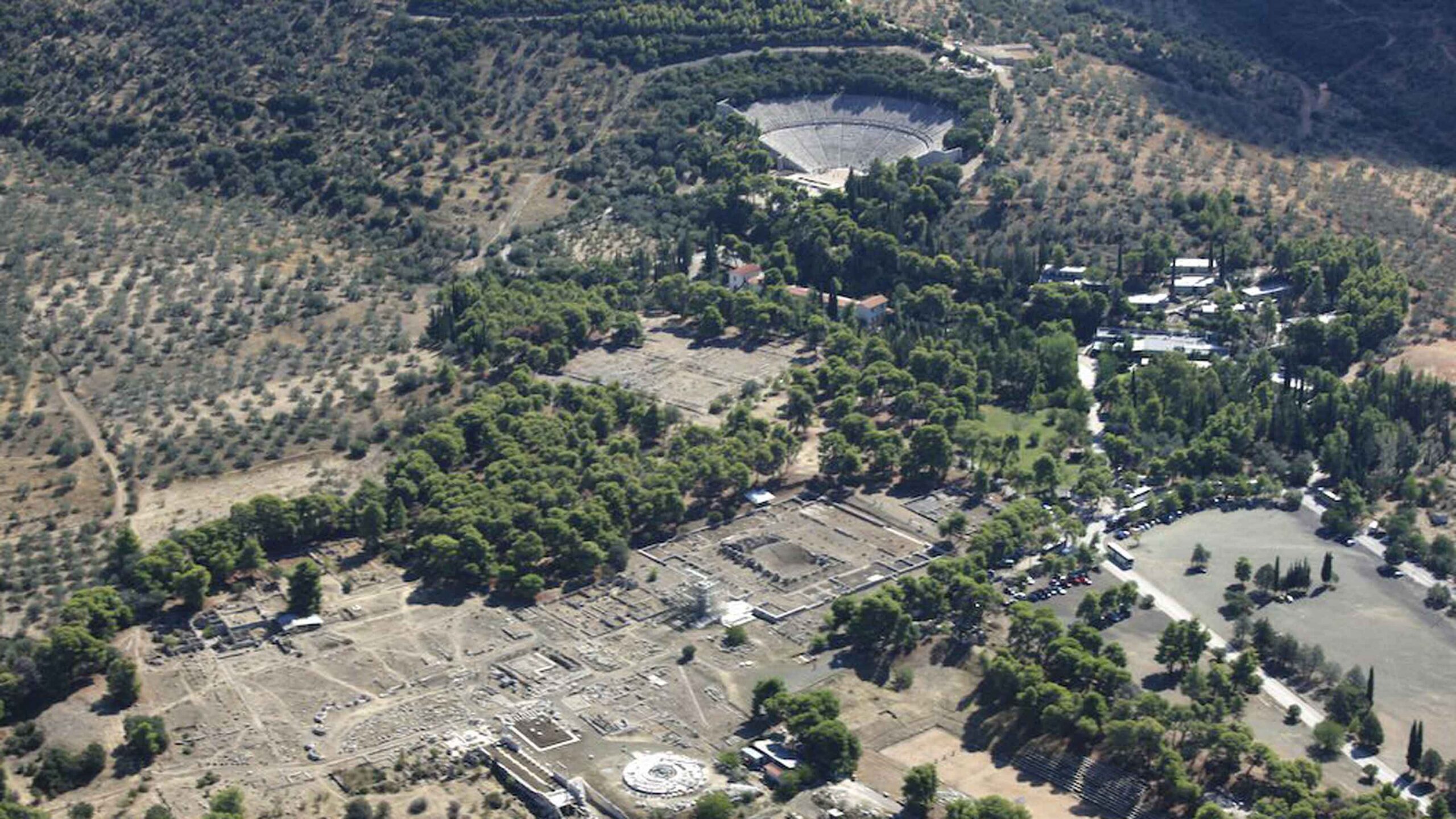
One of the buildings I always wanted to visit was the amphitheater at Epidaurus, Greece. This symbiosis of architecture and nature appealed so much to me that I used it as a motto for my graduation project. A choice I made purely intuitively, based on my aspiration of creating an architecture where nothing would be superfluous and everything would be fitting. Although the theatre was an integral part of an ancient healthcare complex called the Asklepion, I had no idea that my future as an architect would lie in this field of architecture.
The first time I saw a picture of the amphitheatre I was immediately impressed by the organic way it had been integrated into the landscape. It seemed as if nature had reserved a perfect concave valley, only waiting for the semi-circular theatre to settle at that precise location. One can imagine my almost childlike level of curiosity and excitement when, after many years, I finally had the opportunity to visit it.
The Asklepion, built around 350 BC and located nearby the ancient town of Epidaurus on the Peloponnese peninsula, was dedicated to Asklepios, god of healing and health. It consisted of a wide range of buildings, such as temples, a stadium, bath houses, guest rooms and the famous, magnificent theatre. According to the ideas of that time a holistic approach was the only way to cure sick people.
Poetry, music, sports and of course the worship of the appropriate gods were considered to be integral elements of the healing process. There were similar sites scattered across classical Greece and the Roman Empire, but the one at Epidaurus was special. According to the myth, it was the birthplace of Asklepios himself. His famous symbol, a whirling snake, was associated with renewal of life thanks to it’s ability of changing it’s skin.
Other than the theatre two buildings caught my attention. In the enkoimeterion, an elongated building consisting of two floors, patients could spend the night on a bed of snake’s skin. They were visited in their dreams by no other than Asklepios. He gave them therapeutic advise or – when they were really lucky – cured them. In the katagogion, a large building which contained around 160 rooms, patients, their families and other guests could be accommodated. The building was divided into two equally sized mirrored parts, which were completely separated from each other. Benefits of this division were flexibility in capacity and, if necessary, using one of the two halves for isolating purposes.
Walking around the complex of Asklepios I became fascinated by the analogy with contemporary healthcare architecture. Nature, care for both body and soul, the presence of family and caregivers: in the Asklepion it all could be accommodated. As a result of the studies of Evidence Based Design, we know the importance of these elements for the healing process of patients. Nature, Healing Environment, Family Centered Care: for a long time we believed this could be important – longer perhaps there hasn’t been sufficient attention for it.
Nowadays one can’t imagine not providing space for it in hospitals. At EGM architects we are privileged to be able to work on many hospitals of all different sizes: from small rural hospitals to big academic complexes. No matter what scale the hospital, everywhere these aspects are given the utmost care and attention. We provide space for it, both literally and figuratively.
At Epidaurus the classic foundations of the ideal healthcare complex lay crumbled in pieces of stone before my feet. Unfortunately the Goths demolished it in 395 A.D., after which two earthquakes finally completed it’s destruction. It wasn’t until the 19th century that the ruins were recovered.
I started and ended my visit to the Asklepion at the theatre. Sitting at the top tier I enjoyed both the warm, descending December son and the singing of a French tourist who, in her own way, was testing the phenomenal acoustics of the theatre. How far would the development of healthcare architecture had been, I wondered, if the Asklepion hadn’t been hidden under the face of the earth for so many centuries?